While in Gdańsk attending AMBERIF, the largest Baltic amber event in Europe, we had the opportunity to visit the International Amber Association (IAA) Amber Laboratory. During our visit, we brought one of our amber pendants for evaluation — both to better understand the certification process and to share that knowledge with you.
What Does the IAA Amber Laboratory Do?
The IAA Amber Laboratory specializes in testing objects made of Baltic amber or containing amber, issuing official documentation such as certificates or examination reports confirming the results.
According to the IAA appraiser’s guidelines, the laboratory also evaluates:
objects identified as imitations or forgeries
objects made from other fossil resins
In addition to testing, the laboratory provides expert consultations for individual clients, businesses, and scientific institutions.
Each certified item receives a unique identification number, allowing its authenticity to be verified through the official online certificate database.
How Is Amber Tested?
The laboratory uses a combination of advanced scientific methods to determine authenticity:
Macroscopic and microscopic analysis in both visible and ultraviolet light
Mid-infrared (FTIR) spectroscopy, using a specialized spectrometer with a diamond crystal ATR (attenuated total reflection) attachment
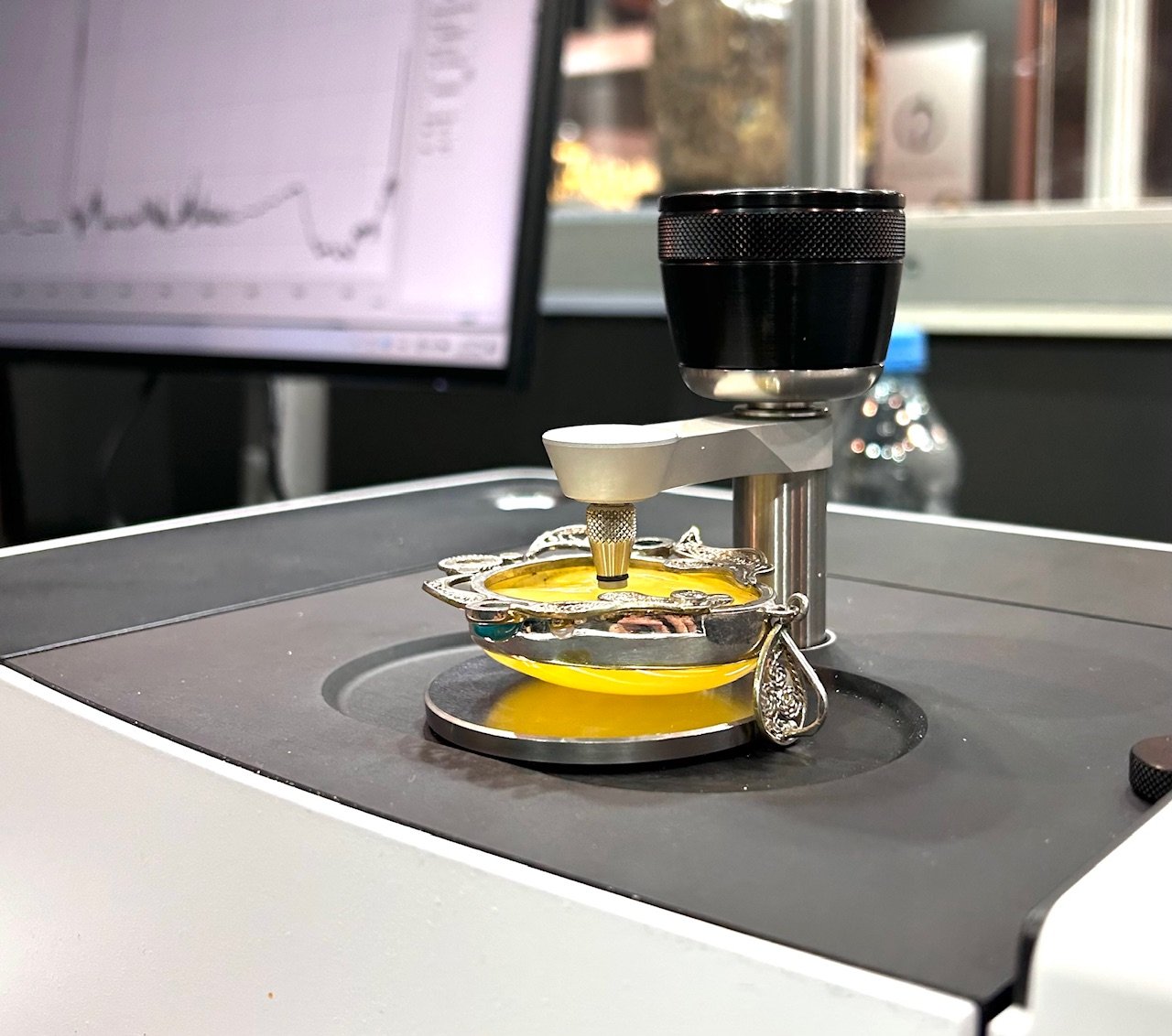
Baltic amber pendant during the testing process
These methods allow experts to analyze the internal structure and chemical composition of amber with high precision.
The “Baltic Shoulder” — A Key Signature
One of the most important indicators of genuine Baltic amber is what specialists call the “Baltic Shoulder.”
Visible in the spectrometer results as a characteristic horizontal line, this feature confirms that the tested material is:
natural
unoxidized
unmodified
In other words, it verifies that the amber is pure Baltic amber in its authentic state.
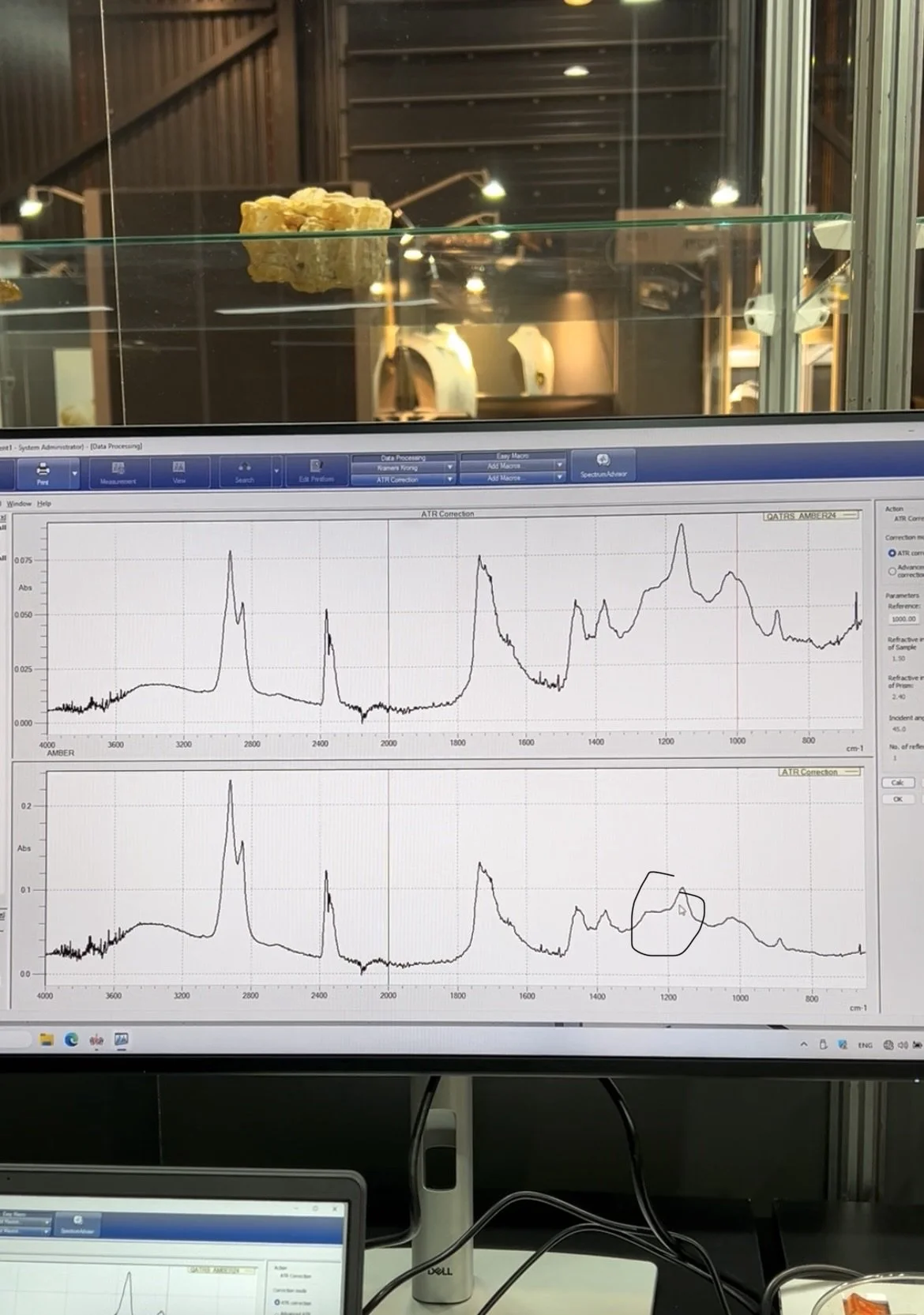
Results of the test for chemical composition of amber, with horizontal line of "Baltic Shoulder" marked by a circle
Understanding the Science Behind the Test
Amber is a complex organic material composed of various chemical compounds. When subjected to infrared radiation during FTIR testing, these compounds respond by vibrating — some chemical bonds contract, while others expand.
Each of these reactions appears as a specific pattern on the spectrum. Scientists interpret these patterns by analyzing the full range of wave numbers, with particular attention given to the “fingerprint region” (approximately 1300–800 cm⁻¹).
This region contains a unique spectral signature — much like a fingerprint — that allows experts to identify Baltic amber and distinguish it from other substances.
Certification and Traceability
Every piece of amber tested in the laboratory receives official documentation confirming the results. This certificate, along with its unique identification number, provides an additional layer of confidence and traceability.
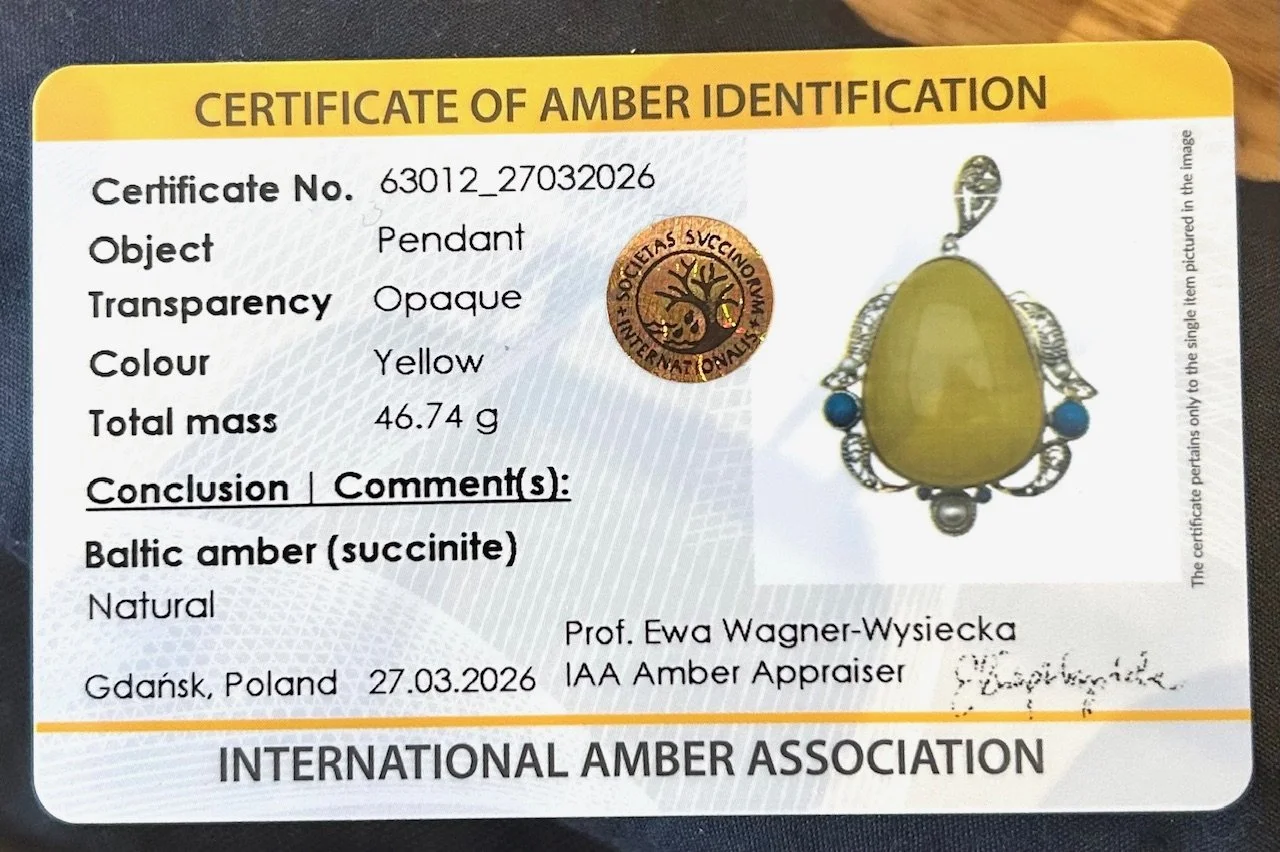
Certification card showing the tested Baltic amber pendant and confirming its identification
Why This Matters
For us, visiting the Amber Laboratory is more than just a technical exercise — it is part of our commitment to authenticity.
At Baltic Ambers Art, we believe that understanding where amber comes from and how it is verified is just as important as appreciating its beauty. By working closely with institutions like the IAA and staying connected to the source in Poland, we ensure that every piece we offer reflects both tradition and truth.
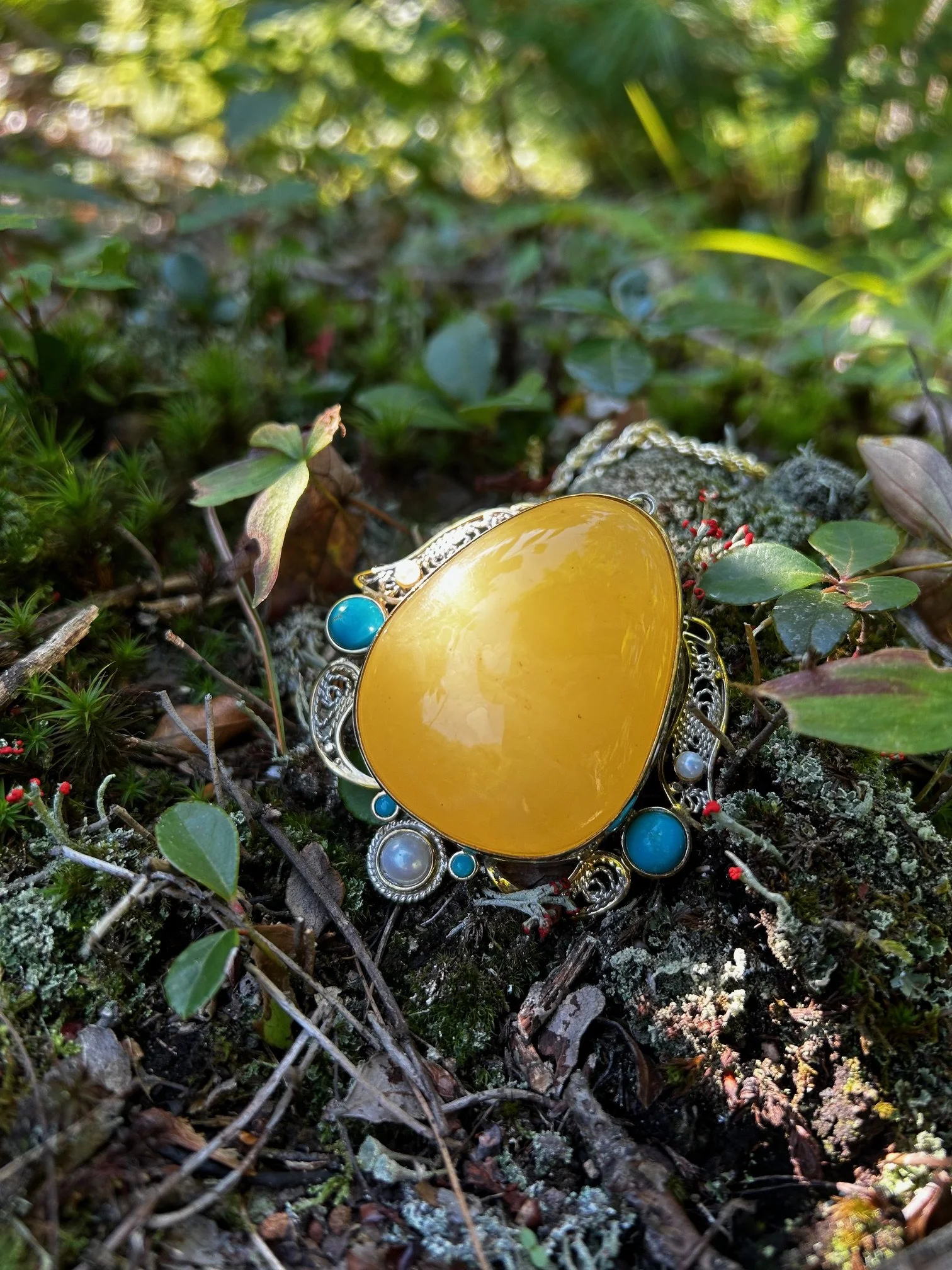
Baltic amber pendant, tested in the laboratory